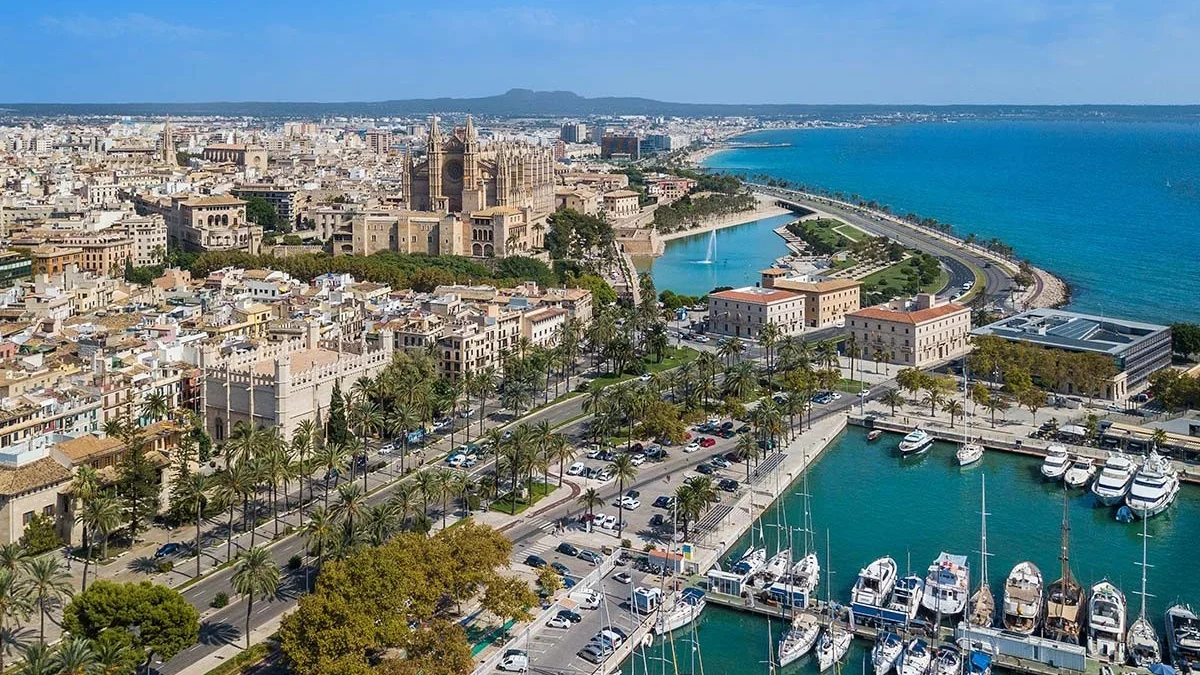
Quick answer: Palma de Mallorca is covered here as a buying market rather than a listings feed: price bands per m2, the areas foreign buyers actually pick, and what the purchase costs on top of the asking price. Palma de Mallorca apartments start from €280,000, with ITP resale tax at 8-13% progressive rates, gross long-term yields of 4-5.5%, and a complete ban on short-term tourist rentals in apartments. Foreign buyers accounted for 29.86% of Balearic transactions in 2025. The Golden Visa property route closed 3 April 2025.
Palma de Mallorca is the Balearic Islands’ capital city and the most liquid urban property market in the Spanish Mediterranean. The Illes Balears recorded a foreign-buyer share of 29.86% in 2025, nearly one-in-three residential transactions completed by an overseas buyer, against a national average of 13.82% (Registradores Anuario 2025). Palma concentrates the deepest pool of international demand on the island, combining UNESCO-listed heritage architecture, a year-round professional economy, and direct flight connectivity to over 30 countries. City apartment prices range from €280,000 in accessible outer districts to over €8,500 per square metre in the Old Town (Casc Antic). However, Palma’s strict ban on short-term tourist rentals in apartments fundamentally reshapes the investment calculus: this is a long-term rental and capital-appreciation market, not a short-let yield play.
Palma de Mallorca Property for Sale: How We Source It
We do not carry standing Palma de Mallorca stock in the verified catalogue right now. What this page gives you instead is the pricing and cost picture you need before you talk to any agent, and if you want Palma de Mallorca specifically we will go to the developers and resale agencies for you rather than sell you what happens to be on the shelf. The rest of this page is the buying detail.
Planning a Palma de Mallorca property purchase? Our Spain advisors connect you with verified local lawyers, licensed agents, and independent tax advisors across Mallorca.
Get Free Palma ConsultationWhy Is Palma de Mallorca a Compelling Property Investment in 2026?
Palma de Mallorca offers structural advantages that distinguish it from seasonal resort markets: a diversified, year-round economy, a large professional tenant base, and genuine international exit liquidity. The Balearic Islands recorded a 29.86% foreign-buyer share in 2025, the highest participation rate of any Spanish region, and Palma captures the majority of that urban Balearic demand.
The city’s economy does not depend solely on tourism: it is home to the regional government, a university with over 15,000 students, a growing digital-nomad and remote-worker community, and major employers in logistics, healthcare and financial services. This economic diversification underpins rental demand from professional tenants rather than seasonal visitors, making long-term lease yields more stable and predictable than in purely tourist-facing resort towns.
Capital values in Palma have appreciated consistently since 2015, with the post-2020 acceleration driven by Northern European relocation capital, principally German, Scandinavian and Dutch buyers, seeking primary or semi-primary residences with Mediterranean lifestyle and high connectivity. Palma Airport (PMI) handles direct flights from London, Frankfurt, Amsterdam, Stockholm, Copenhagen and over 30 other cities, making it the most accessible island capital in Spain. That connectivity reduces the time-horizon friction that constrains competing markets: buyers can view properties over a long weekend, and sellers can reach a continental buyer pool without relying on domestic Spanish demand alone.
Insider tip: Palma is the only Balearic market with a genuine year-round resident economy, which is what separates it from the island’s resort stock. That supports long tenancies through winter and gives you a letting option that does not depend on the ETV quota at all.
What Are Property Prices Across Palma de Mallorca’s Districts?
Palma de Mallorca divides into several distinct investment micro-markets, each with its own price level, tenant demographic, rental yield profile, and lifestyle character. Understanding the district map is essential before committing capital, because the right zone depends on whether your priority is capital appreciation, long-term rental yield, personal lifestyle use, or eventual resale to a defined buyer demographic. Prices below are indicative 2025-2026 ranges compiled from Idealista, Fotocasa and notarial registry data.
The Old Town (Casc Antic / Centro Histórico) is the premium heritage core of Palma. Properties here are predominantly characterful apartments and townhouses in Gothic and Renaissance buildings within walking distance of the Cathedral, La Lonja and the harbour promenade. Renovated apartments in the Old Town command €5,000-€8,500 per square metre, making entry-level purchases around €450,000-€600,000 for a quality two-bedroom unit. Demand comes from lifestyle buyers and long-term professional tenants willing to pay a premium for location; yield plays are secondary to capital preservation here.
Santa Catalina, directly west of the Old Town, is Palma’s most dynamic urban neighbourhood, a former working-class market district now densely populated by restaurants, wine bars, independent boutiques and the Mercat de Santa Catalina. It attracts the strongest professional rental demand in the city. Two-bedroom apartments in Santa Catalina trade at €3,800-€5,200/sqm, with gross long-term yields of 4.5-5.5%. This district consistently ranks as Palma’s best combination of entry price, yield, and resale liquidity.
Portixol and El Molinar form a waterfront belt southeast of the city centre, traditionally a fishing village now transformed into a trendy residential address. The seafront promenade, small harbour, and walkability to central Palma attract affluent remote workers and digital nomads on medium-term leases of 11-18 months. Portixol prices average €4,000-€5,500/sqm, with strong demand sustaining yields of 4-5%.
Son Vida, a gated hillside enclave 5 kilometres northwest of the city centre adjacent to two international golf courses, is Palma’s premier luxury villa district. Detached villas with pool, garden and city or sea views are priced from €1.2 million to well over €5 million. Son Vida operates in a different segment: buyers are typically high-net-worth Northern Europeans seeking primary or second-home status; rental demand is limited and mainly corporate-relocation driven.
Palma de Mallorca Property Prices by District (2025-2026)
| District | Avg Price/sqm (Apartment) | Typical Entry Price | Primary Tenant / Buyer Profile | Gross LT Yield |
|---|---|---|---|---|
| Old Town (Casc Antic) | €5,000-€8,500 | from €450,000 | Lifestyle buyers, professional tenants | 3.5-4.5% |
| Santa Catalina | €3,800-€5,200 | from €320,000 | Professionals, remote workers | 4.5-5.5% |
| Portixol / El Molinar | €4,000-€5,500 | from €350,000 | Digital nomads, affluent renters | 4-5% |
| Son Armadams / West Bay | €3,200-€4,500 | from €280,000 | Families, established residents | 4-5% |
| Son Vida (villas) | €6,000-€10,000 | from €1,200,000 | HNW lifestyle, corporate tenants | 2.5-3.5% |
| Génova / Terreno | €2,800-€4,200 | from €260,000 | Mid-market families, long-term | 4.5-5.5% |
Need a tailored district recommendation based on your budget and investment goals? 's Mallorca advisors provide independent analysis across all Palma neighbourhoods.
Request Palma District AnalysisBuyer scenario: the same budget buys an old-town apartment with strong resale depth or a larger unit in the outer districts with better yield arithmetic. Palma prices the historic centre at a premium that rental income does not fully justify, which is a lifestyle decision rather than an investment one.
Palma spreads across a wide price range for a single city, from roughly €3,200 per m2 in the outer residential districts to about €8,500 in the old town and the seafront, with entry to the market around €280,000. Two rules apply everywhere in that range. Balearic transfer tax on a resale is progressive rather than flat, running from 8% to 13% as the price rises, so a purchase at the top of the city costs materially more to acquire than the same money would in Andalucía at 7%. And short-term tourist letting is prohibited in apartment buildings across the city, which makes long-term rent the only income model available on a Palma flat. Gross yields on that basis run roughly 4% to 5.5%, and an owner resident in the EU or EEA pays 19% of net rental income after deductions rather than 24% of gross.
What Are the Tax Costs for Buying Property in Palma de Mallorca?
Buying costs in Palma de Mallorca include property transfer tax, stamp duty or VAT, notary fees, land registry fees and legal representation, and understanding these before you make an offer is essential to accurate underwriting.
The Balearic Islands apply a progressive ITP (Impuesto de Transmisiones Patrimoniales) for resale property: 8% on the first €400,000 of declared value, 9% on the tranche between €400,001 and €600,000, 10% on €600,001-€1,000,000, 11.5% on €1,000,001-€2,000,000, and 13% above €2,000,000. For a €500,000 Palma apartment, this produces an ITP bill of approximately €41,000 (8% on the first €400,000 = €32,000, plus 9% on the remaining €100,000 = €9,000). New build properties are exempt from ITP and instead pay 10% IVA (Spanish VAT) plus 1.5% AJD (Actos Jurídicos Documentados, stamp duty on the deeds). Total acquisition costs including notary (€1,000-€2,500), registry (€500-€1,500) and independent legal counsel (typically 1% of purchase price) bring the all-in figure to approximately 11-14% of the purchase price for resale, and 13-14% for new build. Buyers must obtain a NIE (Número de Identificación de Extranjero) before completing, a step that typically takes 2-4 weeks and is handled through the Spanish consulate in your country of residence or at the Palma foreigners’ office.
Annual Holding Taxes and NRIT on Rental Income
Non-resident property owners in Palma de Mallorca are subject to NRIT (Non-Resident Income Tax) via Modelo 210, filed quarterly when the property is actively rented. EU and EEA residents pay 19% on net rental income after deducting allowable expenses: mortgage interest, community (HOA) fees, insurance, depreciation (3% of construction value annually), and property management costs. Non-EU nationals pay 24% on gross rental income with no expense deductions permitted, a materially higher effective rate that requires careful modelling. If a non-resident property is not rented out, an imputed income charge of 1.1% of the official cadastral value applies annually as a deemed income proxy, payable at the same NRIT rates. IBI (Impuesto sobre Bienes Inmuebles), the municipal property rates charge, typically runs €400-€1,200 per year for a Palma city apartment depending on cadastral value. Total annual holding costs for a non-resident owner of a €450,000 Palma apartment, including NRIT, IBI, community fees and building insurance, commonly fall in the range of €6,000-€9,500 per year when the property is not rented.
Buyer scenario: the Balearic ITP scale is progressive, so a €400,000 purchase sits at the top of the 8% band at €32,000 while €410,000 crosses into 9% on the excess. Model the band edges before negotiating a price near one.
What Is the Short-Term Rental Situation in Palma de Mallorca?
Palma de Mallorca completely bans short-term tourist rentals in apartments and multi-family residential buildings. This is not a moratorium, a freeze on new licences, or a temporary policy, it is a hard regulatory prohibition under the Ley de Turismo de les Illes Balears, enforced at municipal level by Palma City Hall with fines of up to €40,000 per violation. Any apartment owner advertising on Airbnb, Booking.com or similar platforms in Palma without a valid Estancia Turística licence is operating illegally, and the city actively monitors and fines such operations. The only residential properties in Palma permitted to offer short-term tourist accommodation are detached single-family houses (unifamiliares) and villas, and even those are subject to municipal licensing quotas that are not currently being expanded. Buyers who purchase a Palma apartment expecting to run it as a short-let business are buying into an impossible regulatory situation, no licence application process exists for apartments. This STR ban is the single most important piece of due diligence for any Palma property investor, as it fundamentally determines the income model. The practical consequence is straightforward: Palma is a long-term rental and capital-appreciation market for apartment buyers, and investors must price and underwrite it accordingly.
Red flag: any Palma purchase underwritten on short-let income without an existing ETV licence attached to the property. The city has among the tightest restrictions in Spain, and apartment blocks are largely excluded regardless of the quota position.
District Comparison: Palma de Mallorca Investment Profiles
| District | Entry Price (2BR apt) | STR Allowed | LT Gross Yield | Capital App. Potential | Best For |
|---|---|---|---|---|---|
| Old Town (Casc Antic) | €500,000-€850,000 | No | 3.5-4.5% | High | Lifestyle + capital preservation |
| Santa Catalina | €320,000-€550,000 | No | 4.5-5.5% | High | Yield + urban appreciation |
| Portixol / El Molinar | €350,000-€600,000 | No | 4-5% | High | Remote-worker demand |
| Son Armadams / West Bay | €280,000-€450,000 | No | 4-5% | Medium | Entry-level urban investment |
| Son Vida (villas) | €1,200,000+ | Yes (licensed) | 2.5-3.5% | Medium-High | Lifestyle + HNW exit |
| Génova / Terreno | €260,000-€400,000 | No | 4.5-5.5% | Medium | Affordable long-term yield |
Insider tip: Palma’s districts behave as separate markets with separate buyer pools. Confirm which district a listing sits in before comparing its price to any city average, because the spread between the old town and the outer neighbourhoods is wider than between many Spanish cities.
Did the Golden Visa Close? What Does It Mean for Palma Buyers?
The Spanish Golden Visa real estate route was permanently terminated on 3 April 2025 under Organic Law 1/2025. Prior to that date, non-EU nationals who invested at least €500,000 in Spanish residential or commercial property could obtain a two-year residence permit (renewable for five-year periods), giving access to the Schengen Area and a pathway to permanent residency. That route is now closed with no transitional period for new applicants. Non-EU nationals who purchased in Palma de Mallorca specifically to obtain residency must now explore alternative legal pathways. The Non-Lucrative Visa (NLV) requires demonstrating passive income of at least €2,400/month per applicant plus €600/month per dependent, but does not permit employment in Spain. The Digital Nomad Visa, introduced in 2023, permits remote work for non-Spanish employers and requires proof of employment or client contracts generating at least €2,646/month. Neither visa is triggered by property ownership, they are independent of the investment. For EU citizens, this change is irrelevant: EU nationals have the right of residence in Spain automatically under freedom-of-movement rules and face no restriction on property purchase or residency in Palma.
Pros and Cons of Palma de Mallorca Property Investment
Advantages
High international exit liquidity. With 29.86% of Balearic transactions completed by foreign buyers in 2025, Palma has one of the deepest international resale markets in Mediterranean Europe. Sellers are not dependent on the local Spanish market alone, German, Scandinavian, British and Dutch buyer pools ensure strong competition for quality assets.
Year-round professional rental demand. Unlike resort towns, Palma sustains genuine 12-month rental demand from university students, civil servants, healthcare workers, multinational company staff and the growing remote-worker community. Vacancy periods for well-located Palma apartments are consistently shorter than seasonal resort markets.
Capital appreciation track record. Palma city prices have appreciated by an estimated 40-60% over the decade 2015-2025 in prime districts like Santa Catalina and the Old Town, outperforming the national average. The combination of constrained land supply (island geography), rising construction costs, and structural international demand supports continued upward price pressure.
Strong infrastructure and connectivity. Palma Airport direct routes to 30+ countries, a modern motorway network, a rebuilt urban waterfront, and a functioning public transport system within the city make Palma practically competitive with mainland Spanish cities for residents and businesses.
Risks and Limitations
STR apartment ban eliminates a major income model. For investors who expected to run Palma apartments as short-let units on peak summer yields, the regulatory prohibition is a fundamental deal-breaker. Long-term yields of 4-5.5% are solid but significantly below the 8-12% gross returns sometimes quoted for licensed STR villas elsewhere on the island.
Progressive ITP is expensive at upper price points. A €1 million Old Town apartment in Palma attracts ITP of €88,000 (8% + 9% + 10%), an 8.8% effective rate before notary, registry and legal costs. Total acquisition costs for premium Palma properties commonly reach 12-14%, which means investors need meaningful capital appreciation or sustained rental income before reaching break-even.
Golden Visa closure removes a residency incentive. Non-EU buyers who were motivated by the visa pathway will no longer receive residency rights from a Palma purchase. This removes a segment of demand from the upper-end market and requires buyers to approach the investment purely on financial merit.
NRIT disadvantage for non-EU investors. Non-EU owners pay 24% on gross rental income with no deductions, compared to 19% on net income for EU/EEA residents. For a non-EU investor earning €18,000/year gross rental on a Palma apartment, the NRIT bill is €4,320 versus approximately €1,800-€2,400 for an equivalent EU-resident owner accounting for deductible expenses. This gap makes Palma a structurally more expensive market to hold for non-EU investors.
Seasonal tourism pressure on city infrastructure. Palma received over 12 million airport arrivals in 2024. Summer overcrowding affects transport, services and daily quality of life for residents, which is a growing political and social concern. Municipal policies continue to evolve, additional STR restrictions or tourism caps remain a plausible future regulatory direction.
What Is the Buying Process for a Palma de Mallorca Property?
The Spanish property purchase process in Palma de Mallorca follows a defined legal sequence with several mandatory steps. First, the buyer obtains an NIE (Número de Identificación de Extranjero), a tax identification number required for all property transactions.
This can be obtained at the Palma foreigners’ office or through the Spanish consulate in the buyer’s home country and typically takes 2 to 4 weeks. Second, the buyer’s independent Spanish lawyer conducts property due diligence: verifying title at the Land Registry (Registro de la Propiedad), confirming no outstanding mortgages or charges, checking that IBI (rates) payments are current, verifying building community debts are settled, and reviewing the cadastral records for compliance. For Old Town properties in particular, heritage building regulations may affect renovation rights and require specific municipal permissions. Third, a private purchase contract (contrato de arras) is signed, typically accompanied by a 10% deposit. This contract is legally binding and locks in the price, conditions, and completion timeline, usually 4 to 8 weeks after signing. Fourth, completion takes place before a Spanish notary, where the public deeds of sale (escritura de compraventa) are executed, the balance of the purchase price is transferred, and taxes are paid. The notary registers the transaction at the Land Registry within 15 working days. Total timeline from initial offer acceptance to keys ranges from 6 to 14 weeks depending on mortgage requirements, due diligence complexity, and seller preparedness.
Related Balearic and Spain Guides
Use these companion pages to model Palma against the wider Balearic and national framework:
- Balearic Islands property investment guide
- property for sale in Mallorca
- property for sale in Ibiza
- Mallorca vs Marbella comparison
- Cost of buying property in Spain
Frequently Asked Questions
Palma de Mallorca averages €3,200-€6,500 per square metre for apartments, depending on district. The Old Town (Casc Antic) commands €5,000-€8,500/sqm for renovated historic properties. Santa Catalina and Portixol average €3,800-€5,500/sqm. Son Vida, the prestige residential enclave to the northwest, prices villas from €1.2 million upwards. Entry-level apartments in outer districts such as El Molinar or Génova begin around €280,000-€320,000.
No. Palma de Mallorca imposes a complete ban on short-term tourist rentals in apartments and multi-family buildings. Only detached houses and villas with a valid Estancia Turística licence may operate legally, and those are subject to strict municipal quotas. Buyers expecting Airbnb-style returns from a Palma city apartment will not receive a tourist licence under current law. Palma is exclusively a long-term rental and lifestyle market for apartment owners.
Palma de Mallorca falls within the Balearic Islands' progressive ITP regime. The rate is 8% on the first €400,000, 9% on €400,001-€600,000, 10% on €600,001-€1,000,000, 11.5% on €1,000,001-€2,000,000, and 13% above €2,000,000. New build purchases pay 10% IVA (VAT) plus 1.5% AJD stamp duty instead of ITP. Total acquisition costs including notary, registry and legal fees typically add 10-13% on top of the purchase price.
Long-term residential rental yields in Palma de Mallorca range from 4% to 5.5% gross, broadly in line with Spain's national Q1 2026 average of 5.45% (Global Property Guide). The Portixol waterfront and Santa Catalina districts offer the strongest yield-to-price ratios for professional tenant demand. Non-resident owners pay NRIT at 19% on net rental income if EU/EEA resident, or 24% on gross income if non-EU, which reduces net yields to approximately 3-4.5% after tax and costs.
No. The Spanish Golden Visa real estate route was permanently closed on 3 April 2025 under Organic Law 1/2025. Property purchase in Palma de Mallorca, regardless of value, no longer grants residency or visa rights to non-EU nationals. Residency applications for non-EU buyers must now follow standard immigration routes such as the Non-Lucrative Visa (NLV) or Digital Nomad Visa, which carry income-demonstration requirements unrelated to property ownership.
Get a Spain property shortlist
Tell us your budget and market (Costa Blanca, Costa del Sol, Balearic Islands). We reply within one business day with options matched to your goals.