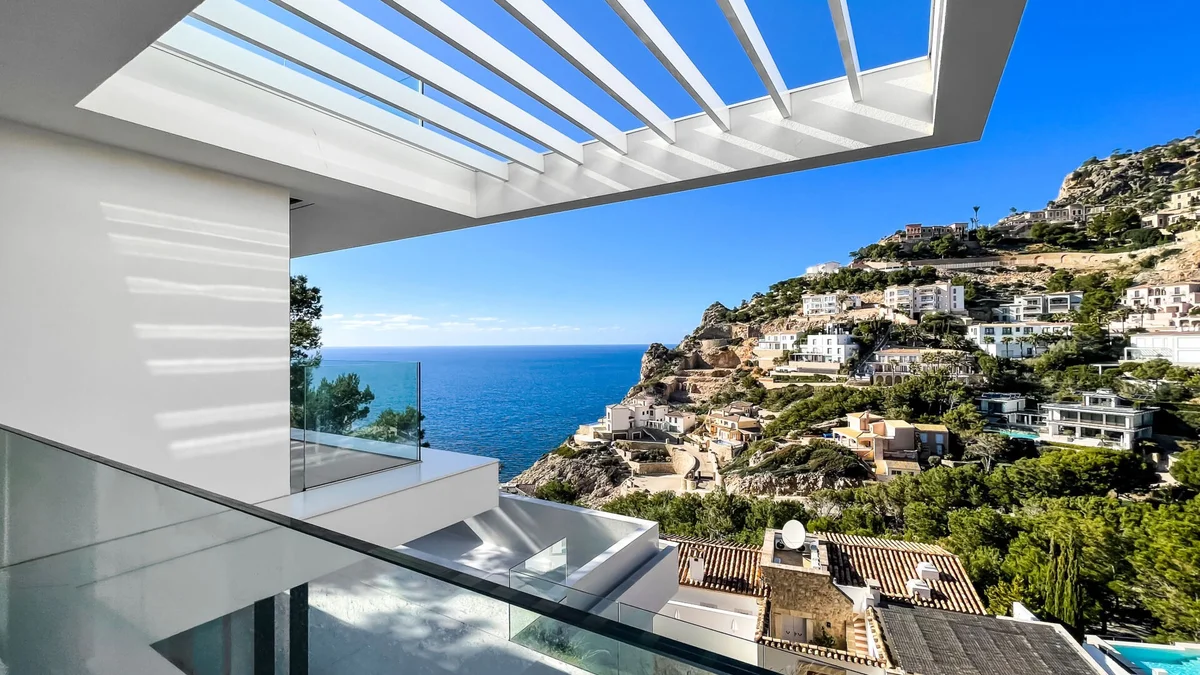
Quick Answer: The Balearic Islands registered a 29.86% foreign buyer share in 2025, Spain’s highest, with Mallorca entry prices starting at €3,500/m², Ibiza at €6,000/m², and Menorca at €2,200/m². Short-term rental licensing is severely restricted or frozen across all three islands. The Golden Visa real estate route ended 3 April 2025. Progressive ITP resale tax reaches 11.5-13% on luxury transactions. Gross yields average 4.2-5.8%.
The Balearic Islands, comprising Mallorca, Ibiza, Menorca, and Formentera, represent one of Europe’s most sought-after and supply-constrained property markets. In 2025, foreign buyers accounted for 29.86% of all residential transactions in the Illes Balears (Balearic Islands), the highest provincial foreign-buyer share in all of Spain, according to the Registradores Anuario 2025. Against a national backdrop of 714,237 residential transactions in 2025, up 11.5% year-on-year, the Balearic Islands stood apart for the depth of international demand and the relentless upward pressure on prices driven by constrained supply, planning restrictions, and a global ultra-high-net-worth buyer base.
This guide covers every critical factor international investors need to understand before committing capital: island-by-island pricing, rental yield realities, the landmark termination of Spain’s real estate Golden Visa in April 2025, the severe short-term rental licensing environment, the progressive ITP transfer tax structure, and the strategic distinctions between Mallorca, Ibiza, and Menorca as investment destinations.
Looking for what is actually on the market? This page is the analysis. Current verified stock with prices is on property for sale in Mallorca.
Our team advises international buyers on Mallorca, Ibiza, and Menorca, from market entry strategy to legal due diligence and STR licensing realities.
Book a Free ConsultationWhy Are the Balearic Islands Attracting Record Foreign Investment in 2026?
The Balearic Islands captured 29.86% of all residential transactions from foreign buyers in 2025, a figure that reflects both the sustained demand from Northern European and German-speaking buyers and the growing interest from American, Middle Eastern, and Asian investors drawn by the islands’ combination of Mediterranean climate, infrastructure quality, and EU legal certainty. Nationally, foreign buyers completed approximately 97,480 transactions, 13.82% of Spain’s residential deals, but within the Balearic Islands the proportion is more than double the national average.
The structural drivers of this demand are well-documented and unlikely to reverse in the medium term. Mallorca alone has a moratorium on new hotel development in most coastal zones, and the Balearic Islands government’s 2022 Law on Touristic Exploitation capped the total number of legally rentable tourist beds across all islands. Supply of buildable land is tightly controlled through the Plan Territorial Insular (PTI) for each island, which preserves large tracts of countryside from development. New-build completions in 2025 represented under 4% of total transactions in the Balearic Islands, a fraction of demand, sustaining the upward price trajectory that has characterised the market since 2016.
The European Central Bank’s rate cycle, which moved from aggressive hiking in 2022-2024 toward cuts from mid-2024 onward, has supported buyer confidence across southern European residential markets. At the same time, the termination of Spain’s real estate Golden Visa on 3 April 2025 under Organic Law 1/2025 removed what had been a residency-via-investment incentive for non-EU buyers committing €500,000 or more. This has not dampened demand materially in the Balearic Islands, where most buyers are lifestyle-driven rather than visa-motivated, but it has altered the buyer profile for the sub-€1,000,000 segment where residency aspirations were historically more common.
Capital appreciation across the Balearic Islands has averaged 6-9% annually over the 2019-2025 period, with the southwest Mallorca coast and Ibiza’s rural luxury corridor recording double-digit annual gains in peak years. The Balearic Islands consistently rank among the three most expensive regional property markets in Spain, alongside Madrid and Barcelona. For a full picture of how the Golden Visa termination affects non-EU buyers, see the Spain Golden Visa ended 2025 guide.
Mallorca, Ibiza, or Menorca: Which Island Offers the Best Investment?
The Balearics are three markets rather than one, and the spread is extreme: Menorca apartments start near €250,000 while Ibiza’s prime villa tier runs to €10,000,000. Mallorca sits between them with the deepest resale pool of the three. They are three distinct investment environments, each with different price points, buyer profiles, rental dynamics, and regulatory frameworks.
Mallorca is the largest island and the deepest market, with the highest volume of transactions, the broadest price range, and the most liquid resale market in the archipelago. Palma de Mallorca functions as a genuine year-round city with an international airport handling over 30 million passengers annually. The southwest coast, encompassing Puerto Andratx, Santa Ponsa, Camp de Mar, and the Son Vida urbanisation above Palma, is one of the most expensive residential markets in southern Europe, with prime villa prices regularly exceeding €10,000,000. The island’s north and interior offer more accessible entry points from €300,000-€600,000 for rural farmhouses (fincas) and village properties.
Ibiza occupies a category of its own in European luxury real estate. The island commands the highest average price per square metre in the Balearic Islands, regularly cited at €6,000-€15,000/m² in prime zones such as Es Cubells, Cap Martinet, Roca Llisa, and the hills of Santa Eulalia del Río. Ibiza’s international profile, driven by its global music and cultural brand, sustains demand from an ultra-high-net-worth clientele willing to pay premiums for privacy, sea views, and architectural quality. Ibiza’s property market is fundamentally capital-appreciation driven rather than yield-driven, given the extreme entry prices and the near-total freeze on new short-term rental licences.
Menorca differs from Mallorca and Ibiza in character and investment rationale. As a UNESCO Biosphere Reserve since 1993, Menorca has strict development controls that permanently constrain supply. Entry prices are lower than both Mallorca and Ibiza, €2,000-€4,500/m² depending on location, making it appealing to buyers who prioritise capital preservation, authenticity, and a quieter lifestyle. However, Menorca’s short-term rental market is effectively closed to new licences in most zones, and the island’s shorter tourist season (June-September) limits both occupancy and gross rental income. Menorca suits the patient, long-term capital preservation buyer more than the active income investor.
Buyer scenario: €500,000 buys a well-positioned Mallorca apartment with genuine resale depth, or a Menorca property with more space and a thinner exit, or almost nothing worth owning in prime Ibiza. The budget does not choose the island; the exit horizon does.
What Are Property Prices Across the Balearic Islands in 2026?
Balearic prices run from around €2,500/m² in inland Menorca to €11,000/m² in prime Ibiza, with Mallorca apartments typically €3,800 to €6,500/m² and entry from €350,000 to €550,000. Prices span that range depending on island, location, property type, and proximity to the coast. The following table summarises current market price ranges across key areas, based on 2025-2026 transaction data and active listings. For a broader comparison of acquisition costs across Spain, see the complete guide to buying costs in Spain.
| Location | Property Type | Price Range (€/m²) | Typical Entry Price |
|---|---|---|---|
| Palma de Mallorca (city centre) | Apartment | €3,800-€6,500 | €350,000-€550,000 |
| Palma de Mallorca (Old Town) | Apartment / Townhouse | €5,000-€9,000 | €500,000-€1,200,000 |
| Southwest Mallorca (Puerto Andratx) | Villa | €6,500-€14,000 | €2,000,000-€12,000,000+ |
| Southwest Mallorca (Santa Ponsa) | Apartment / Villa | €4,000-€8,500 | €450,000-€3,000,000 |
| Northern Mallorca (Pollença, Alcúdia) | Villa / Finca | €3,000-€6,000 | €600,000-€3,500,000 |
| Inland Mallorca (rural finca) | Finca / Farmhouse | €1,800-€3,500 | €300,000-€1,500,000 |
| Ibiza (Santa Eulalia del Río) | Villa / Apartment | €5,500-€12,000 | €700,000-€5,000,000 |
| Ibiza (Es Cubells, Cap Martinet) | Luxury Villa | €8,000-€18,000+ | €2,000,000-€20,000,000+ |
| Ibiza (Ibiza Town) | Apartment / Penthouse | €6,000-€11,000 | €550,000-€3,000,000 |
| Menorca (Ciutadella, Mahón) | Apartment / Townhouse | €2,200-€4,500 | €250,000-€800,000 |
| Menorca (coastal villas) | Villa | €3,500-€7,000 | €600,000-€3,000,000 |
| Formentera | Villa / Apartment | €7,000-€20,000+ | €1,500,000-€15,000,000+ |
These figures reflect asking prices in active market conditions. The Balearic Islands premium over mainland Spain is structural rather than cyclical: the combination of supply caps, international demand concentration, and geographic scarcity means price softening even during European economic downturns has historically been shallow and short-lived compared to mainland coastal markets.
Whether your budget is €400,000 or €5,000,000, our experts can identify the highest-potential properties across Mallorca, Ibiza, and Menorca right now.
Request Your ShortlistInsider tip: compare islands on price per square metre rather than on entry price. A €350,000 Mallorca apartment and a €350,000 Menorca apartment are very different assets in size and location, and the per-metre figure is the only number that makes them comparable.
How Do Mallorca, Ibiza, and Menorca Compare as Investments?
| Factor | Mallorca | Ibiza | Menorca |
|---|---|---|---|
| Entry price (apartments) | €350,000-€550,000 | €550,000-€900,000 | €250,000-€450,000 |
| Entry price (villas) | €600,000-€3,000,000 | €1,500,000-€8,000,000 | €500,000-€2,000,000 |
| Average price/m² (prime) | €5,000-€12,000 | €7,000-€18,000 | €3,000-€6,500 |
| Gross rental yield (long-term) | 4.0-5.5% | 2.5-4.5% | 3.5-4.8% |
| STR licensing | Palma apartments banned; villas limited quotas | Near-total moratorium | Near-total moratorium |
| Market liquidity | High (deepest market) | Medium (premium, niche) | Low-Medium |
| Capital growth (5yr avg) | Strong (6-9%) | Very strong (8-12%) | Moderate-Strong (5-8%) |
| Buyer profile | Mixed: families, HNW, investors | UHNW, luxury lifestyle | Families, nature buyers |
| Year-round rental demand | Yes (Palma city market) | Mainly seasonal | Mainly seasonal |
| Airport connections | Excellent (30M+ pax/year) | Good (8M+ pax/year) | Limited (seasonal) |
Mallorca is the most versatile investment destination in the Balearic Islands because it combines city market dynamics in Palma, luxury coastal demand on the southwest coast, and a mid-market segment in the north and east that offers more accessible entry. Ibiza suits buyers with a long investment horizon who prioritise capital appreciation and are comfortable with very high entry prices. Menorca suits conservative buyers with long-term horizons who value natural heritage and lower price volatility.
What Taxes Will You Pay When Buying Property in the Balearic Islands?
The Balearics operate their own ITP scale, and it is progressive rather than flat: 8% up to €400,000 and 9% from €400,001, rising further in the upper bands. On an island where entry prices are high by Spanish standards, that band structure costs real money. The archipelago operates its own progressive ITP (Impuesto de Transmisiones Patrimoniales) resale transfer tax structure, one of the most progressive in Spain. For full detail on how Spain’s property taxes apply nationally, see the Spain property transfer tax guide (ITP and IVA).
Resale properties pay ITP on a sliding scale: 8% on the first €400,000 of the declared purchase price; 9% on the tranche from €400,001 to €600,000; 10% on the tranche from €600,001 to €1,000,000; 11.5% on the tranche above €1,000,000; and up to 13% for luxury properties transacting above €1,000,000 or €2,000,000 depending on classification. This means a buyer acquiring a resale villa in Puerto Andratx for €3,000,000 would pay approximately €265,000 in ITP alone.
New-build properties incur 10% IVA (VAT) plus 1.5% AJD stamp duty. Total acquisition costs, including notary fees (€1,500-€3,000), land registry fees (€800-€2,000), and independent solicitor fees (0.5-1% of purchase price), typically reach 12-15% on top of the purchase price on high-value Balearic transactions.
Annual holding costs add further to the total investment outlay. IBI (Impuesto sobre Bienes Inmuebles, the annual council tax) typically runs €1,500-€12,000 per year depending on cadastral value, and premium villas in southwest Mallorca or Ibiza can carry IBI of €8,000-€20,000 per year. Community fees for apartments and gated urbanisations range from €1,200 to €20,000 per year depending on shared facilities.
Non-resident rental income tax (NRIT) applies at 19% for EU and EEA residents and 24% for non-EU residents. EU residents may deduct legitimate expenses (maintenance, insurance, management fees, depreciation) from the taxable base; non-EU residents are taxed on gross rental income with no deductions permitted. This is a material distinction: a non-EU buyer generating €80,000 gross rental income pays €19,200 in NRIT with no deductions, whereas an EU resident may reduce the taxable base substantially. Full analysis of NRIT is available in the non-resident income tax on Spain rental guide.
Spain also reintroduced a Solidarity Tax on Wealth at 0.5-1.5% on assets above €3,000,000, assessed on Spanish-sited assets with no primary residence exemption for non-residents. Capital gains tax on resale is 19% for both EU and non-EU non-residents (aligned since 2015), with a 3% withholding retained by the buyer at notary and reclaimable after filing.
Buyer scenario: a €400,000 purchase sits at the top of the 8% band at €32,000. A €410,000 purchase crosses into 9% on the excess, so a €10,000 price increase costs more than €10,000 in total outlay. Model the band edges before negotiating a price near one.
Balearic transfer tax is progressive rather than flat, which is the single most important tax fact for a buyer comparing the islands with the mainland. A resale climbs through bands from 8% to 13% as the price rises, against a flat 7% in Andalucía at any price and 9% under €1,000,000 in the Valencian Community. On a €1,000,000 purchase that difference runs into tens of thousands payable at completion. New build carries 10% IVA plus AJD as on the mainland. Add notary at €600 to €1,200, land registry at €400 to €800 and legal fees at 1% to 1.5%, and budget 10% to 15% over the price in total here. Non-resident income tax then applies annually at 19% of net rental income for an owner resident in the EU or EEA and 24% of gross for everyone else.
Can You Legally Rent Out Your Balearic Islands Property to Tourists?
Balearic short-let licensing is the most restrictive in Spain. The islands operate capped ETV quotas rather than open registration, licences trade at a premium because supply is fixed, and several municipalities have frozen new issuance entirely. Licensing here is among the most restrictive in Europe. Buyers who purchase with rental income as their primary return mechanism must conduct thorough due diligence before completing any acquisition. For a comprehensive national overview of the licensing system, see the short-term rental licence guide for Spain.
Palma de Mallorca enacted an outright ban on short-term tourist rentals in apartment buildings within the city in 2018, which remains in full force as of 2026. The only properties eligible for STR licences in Palma are standalone detached houses. The number of licences for eligible property types is capped and effectively closed in most neighbourhoods.
Mallorca outside Palma operates under the Balearic Islands Tourism Law (Law 6/2017 and subsequent amendments). Tourist rental licences for detached houses and villas (viviendas de comercialización turística, or VCT) require: the property to be a standalone house not located in an apartment building; approval from the Consell Insular de Mallorca or the relevant municipal authority; consent from the comunidad de propietarios (homeowners’ association) where applicable, a 3/5 majority vote is required; and compliance with minimum size and accessibility standards. In many zones, licence numbers are capped under a quota ceiling (plafó), and once the cap is reached no new licences are issued regardless of property type or quality.
Ibiza and Formentera operate under an essentially complete moratorium on new tourist rental licences introduced in 2017 and renewed repeatedly since. The Consell Insular d’Eivissa has not opened new licence applications for the vast majority of zones since 2018. Buyers targeting Ibiza property for short-term rental income must acquire an existing property that already holds a valid, transferable STR licence, and such properties command a significant premium at point of sale.
Menorca introduced a moratorium on new STR licences in 2020 and has extended it through 2026. Properties with existing licences in Menorca are rare and highly valued. The island’s shorter tourist season, approximately 14 peak weeks, further limits gross rental income even for licensed properties.
Long-term rentals (11 months or longer under a standard arrendamiento de vivienda contract) are not subject to STR licensing restrictions and remain viable across all three islands. Palma de Mallorca has a well-developed long-term rental market driven by international residents, digital nomads, and seasonal workers, with gross yields of 4.0-5.2% for well-located apartments in popular districts.
The strategic implication for buyers is clear: purchasing an unlicensed apartment with the expectation of STR income is illegal and carries fines of up to €400,000 for operating without a licence. Only buyers acquiring properties with existing, transferable licences should underwrite STR income into their investment case.
Red flag: any Balearic purchase underwritten on short-let income without an existing ETV licence attached to the property. The quota system means new licences may simply be unavailable, and a property without one cannot be legally let to tourists at any price.
What Is the Step-by-Step Process to Buy Property in the Balearic Islands?
The purchase sequence is standard Spanish conveyancing with one Balearic difference: the ETV licence question has to be settled before the arras, not after. Expect a reservation of €5,000 to €10,000, then around 10% at private contract, then the balance at notary. It follows standard conveyancing process, with several island-specific considerations that international buyers must plan for in advance.
Step 1, Obtain your NIE (Número de Identificación de Extranjero). The NIE is Spain’s tax identification number for foreigners and is mandatory for any property purchase. EU citizens apply at the nearest police station in Spain or at a Spanish consulate in their home country. Processing typically takes 2-4 weeks; in peak summer months, allow 4-6 weeks. Non-EU buyers follow the same process.
Step 2, Open a Spanish bank account. A euro-denominated Spanish bank account is required to pay purchase costs at notary and meet ongoing tax obligations. Major banks active in Mallorca and Ibiza include CaixaBank, Santander, Bankinter, BBVA, and Sabadell. Non-resident account opening requires passport, NIE, proof of address, and proof of income source.
Step 3, Instruct an independent solicitor. In the Balearic Islands, buyers should appoint their own abogado separate from any lawyer recommended by the developer or seller’s agent. Your solicitor will conduct title searches at the Registro de la Propiedad, verify urban planning status, check for charges and mortgages, confirm STR licence status and transferability, and review the private purchase contract.
Step 4, Reservation and private contract. The buyer pays a reservation fee (typically €5,000-€10,000) to take the property off the market, followed by signing a private purchase contract with a deposit of typically 10% of the purchase price. Under the Spanish arras penitenciales (penalty deposit) structure, if the buyer withdraws the deposit is forfeited; if the seller withdraws the seller repays double the deposit.
Step 5, Due diligence period. Your solicitor uses the 4-6 weeks between private contract and completion to verify all legal, technical, and administrative aspects of the property, including STR licence validity, building permits, community fee arrears, and IBI payment history.
Step 6, Completion at notary. The final deed (escritura de compraventa) is signed before a Spanish notary. The balance of the purchase price, plus all taxes and costs, is paid at this point via bank transfer or certified banker’s draft. The notary lodges the deed with the Land Registry.
Step 7, Post-completion filings. Within 30 days of completion, ITP or IVA/AJD must be declared and paid to the Balearic Islands Tax Agency (ATIB). The new ownership is registered at the Registro de la Propiedad. Your solicitor registers you for IBI and community fees as the new owner.
Remote buyers can grant a notarised power of attorney to their Spanish solicitor to act at notary on their behalf, a common arrangement for international buyers. The POA can be executed at a Spanish consulate abroad or before a local notary with an apostille for recognition in Spain.
Checklist: confirm the ETV position before the arras, obtain the nota simple and community certificate, budget the progressive ITP band that applies to your exact price, arrange the NIE and Spanish bank account early, and allow for the higher legal fees island purchases typically carry.
Pros and Cons of Investing in Balearic Islands Property
The Balearic case rests on genuine scarcity: strict land-use law caps new development, 29.86% of transactions go to foreign buyers, and entry runs from €400,000 to well over €5,000,000. The cost is the highest ITP scale in Spain and the tightest letting regime. Any honest analysis must acknowledge both the compelling structural strengths and the significant risks. The following is an evidence-based assessment.
Advantages
Hard supply constraints sustain long-term capital growth. The combination of PTI planning regulations, tourism law moratoria, and the geographic limits of island landmass means new supply will remain structurally constrained. This creates a strong floor under prices in prime locations that has historically limited downside during European economic downturns.
Deep international liquidity on the sell-side supports exit strategies. Mallorca’s resale market, particularly in Palma and the southwest coast, has a global buyer pool. Properties priced correctly sell within 60-120 days in most market conditions, which is relatively fast by southern European standards.
Mallorca’s year-round city market provides income stability. Palma de Mallorca is a genuine Mediterranean city with international schools, world-class healthcare, and a 12-month residential rental market. This provides income continuity for buy-to-let investors beyond the summer tourist season.
High-quality EU legal framework protects buyers. Spain operates a mature land registry and notarial system with strong buyer protection provisions for off-plan purchases, mandatory bank guarantee requirements under Spanish development law mean stage payments must be ring-fenced. Title security is high relative to many non-EU markets.
Euro-denominated asset in a stable jurisdiction. For buyers from the UK, USA, Middle East, or Russia, a Balearic Islands property represents a hard asset in a stable currency and political environment with predictable property rights, enforceable contracts, and EU membership.
Risks and Limitations
STR licensing is effectively frozen for most buyers. For buyers seeking holiday rental income, the inability to obtain a new tourist rental licence in most of the Balearic Islands is the single most material constraint. Buyers who do not already own a licensed property face the choice of operating illegally (fine risk up to €400,000), relying solely on long-term rental returns at lower yield, or paying a significant premium for the rare licensed property.
High progressive ITP on resale transactions is a major cost. A buyer paying €2,000,000 for a Mallorca villa incurs approximately €175,000 in ITP transfer tax alone, and a €5,000,000 transaction generates over €500,000 in ITP. This acquisition cost burden significantly extends the effective payback period for capital return strategies compared to markets with flat transfer taxes.
Golden Visa termination reduced non-EU buyer motivation. The removal of the property-linked residency route from April 2025 has softened demand from buyers who purchased primarily for immigration purposes. The full effect on sub-€1,000,000 non-EU demand is still being assessed in the 2026 market cycle.
Seasonal income risk affects most island properties outside Palma. The Balearic Islands rental market outside the city is fundamentally seasonal. Properties in northern Mallorca, coastal Menorca, or Ibiza’s countryside generate the majority of their potential rental income in a 12-16 week peak season. Void periods of 36-40 weeks require substantial capital reserve discipline.
Wealth tax and future legislative risk. Spain’s Solidarity Tax on Wealth on assets above €3,000,000 and ongoing political debate around housing in the Balearic Islands, several regional governments have discussed additional buyer restrictions, represent legislative risk. The Balearic Islands ecotax (Ecotassa) adds a nightly charge passed to renters that may affect occupancy elasticity in price-sensitive segments.
Off-plan delivery risk in a complex planning environment. The Balearic Islands’ planning system is complex, and new development projects can face delays of 12-24 months due to licence challenges, environmental objections, and supply chain constraints. Buyers of off-plan should ensure bank guarantees are in place from day one of deposit payment.
Key Investment Zones in Mallorca
Mallorca divides into four corridors with a price range wider than most Spanish provinces: from around €5,000/m² in the accessible zones to €9,000/m² and above in the southwest, where villas reach €1,500,000 to €12,000,000. Each corridor serves a different buyer, and they divide into four distinct market corridors, each appealing to a different buyer profile and investment strategy.
The Southwest Coast, encompassing Puerto Andratx, Camp de Mar, Santa Ponsa, and Portals Nous, is the island’s luxury heartland, with villa prices from €1,500,000 to over €12,000,000 and an established ultra-high-net-worth buyer base drawn from Germany, Switzerland, Scandinavia, the UK, and the Middle East. Capital growth here has been the strongest on the island over the past decade, though rental yields are relatively low given entry costs. The southwest is best suited to buyers prioritising capital preservation and resale liquidity over current income.
Palma de Mallorca functions as both a luxury urban market and a mid-market buy-to-let destination. The historic Old Town (Casc Antic) commands €5,000-€9,000/m² for renovated apartments and palaces. Districts such as Santa Catalina, El Molinar, and Son Quint offer prices of €3,500-€6,000/m² with strong long-term rental demand from Palma’s growing international residential population, estimated at over 50,000 foreign residents in 2025. Palma remains the only zone in the Balearic Islands with a genuine 12-month rental market capable of sustaining buy-to-let investment without reliance on tourist rental licensing.
The North Coast, including Pollença, Alcúdia, Port de Pollença, and the Serra de Tramuntana UNESCO World Heritage mountain villages, appeals to buyers seeking architectural character, rural landscape, and a lower-density resort environment. Entry prices range from €400,000 for village apartments to over €3,000,000 for large rural estates with agricultural land.
The East Coast, with Cala d’Or, Santanyí, and Porto Colom, offers more affordable entry into the Mallorca market, with properties from €300,000 and a predominantly European family buyer profile. This coast has seen growing interest from German and Scandinavian buyers seeking value relative to the premium southwest, and it offers the most realistic entry point for investors with a €400,000-€800,000 budget.
Insider tip: Mallorca’s resale depth is its real advantage over the other two islands, and it varies sharply by corridor. Ask how many comparable units sold in that specific zone over the last twelve months before accepting any price as market.
Key Investment Zones in Ibiza
Ibiza concentrates into a handful of ultra-premium zones where villas run €5,000,000 to €10,000,000 and per-square-metre pricing reaches €11,000. The island has the highest short-let yields in the Balearics for licensed stock and the highest entry cost for everything. It is concentrated in a small number of ultra-premium zones that function differently from conventional holiday property markets.
Es Cubells and the southwest coast command the highest prices on the island, and among the highest in Spain, for contemporary villas with panoramic sea views, infinity pools, and international architectural design. Transactions above €5,000,000 are routine; properties above €10,000,000 are common. These properties rarely enter the rental market given their scale and the privacy priorities of their owners.
Cap Martinet and Roca Llisa, in the northeast above the marina of Santa Eulalia del Río, attract a privacy-focused buyer base with properties set in extensive landscaped grounds. Santa Eulalia del Río itself is the island’s largest resort town outside Ibiza Town and has a growing year-round residential community, making it one of the few areas in Ibiza with viable long-term rental demand for appropriately priced apartments and villas.
Ibiza Town (Eivissa) and its immediate surrounds, including the UNESCO World Heritage old town of Dalt Vila, the Figueretes neighbourhood, and Talamanca Bay, offer an urban apartment and penthouse market at €5,000-€11,000/m². These properties attract buyers who value walkability, cultural amenity, and marina access over rural privacy. Ibiza Town apartments are the only Ibiza properties that can realistically be marketed to long-term renters rather than exclusively holiday guests.
The rural hinterland of San José (Sant Josep de sa Talaia) in the south and west of the island remains a reserve for very large private estates where privacy, land area, and architectural scale are the primary value drivers. Properties in this zone rarely transact below €3,000,000.
Methodology: Ibiza pricing is driven by a small number of transactions at the top end, so averages mislead more here than anywhere else in Spain. Treat any per-metre figure for the island as indicative and underwrite the specific zone and the specific licence position instead.
Key Investment Zones in Menorca
Menorca is the value entry to the Balearics at €2,500 to €4,500/m², with apartments from €300,000 and villas reaching €1,500,000. It has the least development pressure and the thinnest resale market of the three islands. Its principal cities are Mahón (Maó) in the east and Ciutadella in the west, anchor the island’s residential market, with distinctly different characters and buyer profiles.
Mahón is notable for its extraordinary natural harbour, one of the deepest and longest natural harbours in the Mediterranean, and its concentration of 18th-century British colonial architecture that makes it architecturally unique among the Balearic Islands. Townhouses and apartments in the Mahón historic centre trade at €2,500-€4,500/m². The city has a growing digital nomad and remote-working community, supported by reasonably priced long-term rentals compared to Mallorca and Ibiza.
Ciutadella is the cultural capital of Menorca, with a compact medieval old town and a reputation for artisan production, gastronomy, and slow-travel tourism. Townhouses here start at approximately €300,000 and can reach €1,500,000 for fully restored historic properties with original features. Ciutadella’s authenticity and relative insulation from mass tourism make it appealing to buyers who value cultural heritage alongside investment rationale.
Coastal villas in Menorca’s protected coves, including Cala Galdana, Son Bou, Arenal d’en Castell, and the exclusive private urbanisations of the north coast, represent the premium end of the Menorca market, with prices of €3,500-€7,000/m² for sea-view properties. Buyers of coastal villas in Menorca should budget for higher maintenance costs due to the island’s strong winter winds (the tramuntana from the north and the garbí from the southwest), which can accelerate weathering of exterior finishes and structural elements considerably faster than in the more sheltered bays of Mallorca.
Menorca’s investment case ultimately rests on long-term capital preservation, UNESCO-protected supply constraints, and the island’s permanent limitation on development rather than on current income generation. Buyers who purchase early in emerging residential zones, particularly around the expanding communities north of Mahón, have historically seen above-average appreciation relative to entry prices, though the island’s total transaction volumes remain modest by Mallorca standards.
Short-let rules in the islands keep moving; the Balearic STR restrictions update tracks the current position.
Frequently Asked Questions
The Balearic Islands remain one of Europe's strongest luxury property markets. Foreign buyers accounted for 29.86% of all transactions in 2025, the highest provincial share in Spain, according to Registradores Anuario 2025. Entry prices in Mallorca range from €3,500 to over €12,000 per square metre depending on location. Capital growth has outpaced mainland Spain over the past decade, though strict short-term rental licensing and supply constraints mean investors must plan carefully before committing capital.
Gross rental yields across the Balearic Islands average 4.2-5.8% on well-located properties, slightly below Spain's national gross average of 5.45% (Global Property Guide, Q1 2026). Net yields after NRIT (19% for EU residents, 24% for non-EU), community fees, management fees, and vacancy typically land 2.5-3.5% per annum. Long-term rental yields in Palma de Mallorca run 4.0-5.2% gross for well-located apartments.
Yes, there are no nationality restrictions on property purchases in the Balearic Islands. Every buyer needs an NIE (Número de Identificación de Extranjero) and a Spanish bank account. Non-EU buyers pay non-resident income tax (NRIT) at 24% on rental income versus 19% for EU and EEA residents. Spain's real estate Golden Visa was terminated on 3 April 2025 under Organic Law 1/2025; property purchase no longer grants residency rights.
New-build properties in the Balearic Islands incur 10% VAT (IVA) plus 1.5% AJD stamp duty. Resale properties pay the progressive ITP transfer tax: 8% on the first €400,000, 9% from €400,000 to €600,000, 10% from €600,000 to €1,000,000, 11.5% above €1,000,000, and up to 13% for luxury transactions above €2,000,000. Budget total acquisition costs of 12-15% on top of the purchase price to cover all taxes, notary, registry, and legal fees on high-value Balearic transactions.
Short-term tourist rentals in the Balearic Islands are among the most restricted in Spain. Palma de Mallorca completely bans short-term tourist rentals in apartment buildings; only detached houses and villas may apply under strict quotas. Ibiza and Menorca operate near-total island-wide moratoria on new STR licences. HOA (comunidad de propietarios) approval is required for any STR application. Operating without a licence carries fines of up to €400,000.
Practical entry prices for the Balearic Islands start at approximately €300,000-€400,000 for a studio or one-bedroom apartment in inland Mallorca or secondary Menorca towns. Palma de Mallorca apartments begin around €350,000-€450,000. Ibiza entry prices start at €500,000 for a small apartment. Budget a minimum of 12-15% on top of the purchase price for acquisition taxes and fees.
Spain's real estate Golden Visa, which granted residency via a minimum €500,000 property purchase, was officially terminated for new applicants on 3 April 2025 under Organic Law 1/2025. Buyers who completed before that date retain their existing rights. Buyers seeking Spanish residency should now explore the Digital Nomad Visa or Non-Lucrative Passive Income Visa with a licensed immigration lawyer specialising in Spanish law.
Mallorca offers the deepest market, highest liquidity, and the broadest range of entry prices from €300,000 to over €10,000,000. Ibiza commands the highest per-square-metre values in the Balearic Islands, driven by an international ultra-high-net-worth clientele, and suits buyers prioritising long-term capital appreciation over income yield. Menorca appeals to buyers seeking capital preservation, lower entry prices, and a UNESCO-protected natural environment. The best choice depends on budget, yield versus capital growth priority, and holding period.
A resale purchase in the Balearic Islands typically completes in 6-10 weeks from accepted offer, assuming clean title and no mortgage. Off-plan projects take 18-36 months to completion. Remote buyers can grant a notarised power of attorney to their Spanish solicitor to act at notary on their behalf. NIE processing takes 2-4 weeks if you do not already have one. Allow additional time in summer months when notaries and registries experience peak volume.
The primary risks include: the effectively frozen STR licensing environment that caps rental income potential for most properties; the progressive ITP resale tax reaching 11.5-13% on high-value transactions; the termination of the Golden Visa removing a residency incentive for non-EU buyers; annual IBI and community fee costs of €3,000-€20,000 per year on premium properties; and Spain's solidarity wealth tax on assets above €3,000,000. All buyers should instruct an independent solicitor and conduct thorough legal due diligence before exchange.
Buyer scenario: a buyer choosing Menorca over Mallorca typically gains 30% to 40% more space for the same money and accepts a materially thinner resale market. That trade works over a long hold and against you if you may need to sell within three years.
Get a Spain property shortlist
Tell us your budget and market (Costa Blanca, Costa del Sol, Balearic Islands). We reply within one business day with options matched to your goals.