- From
- €240,000
- Developer
- Grupo Insur
- Area
- Seville
- Status
- Off-plan
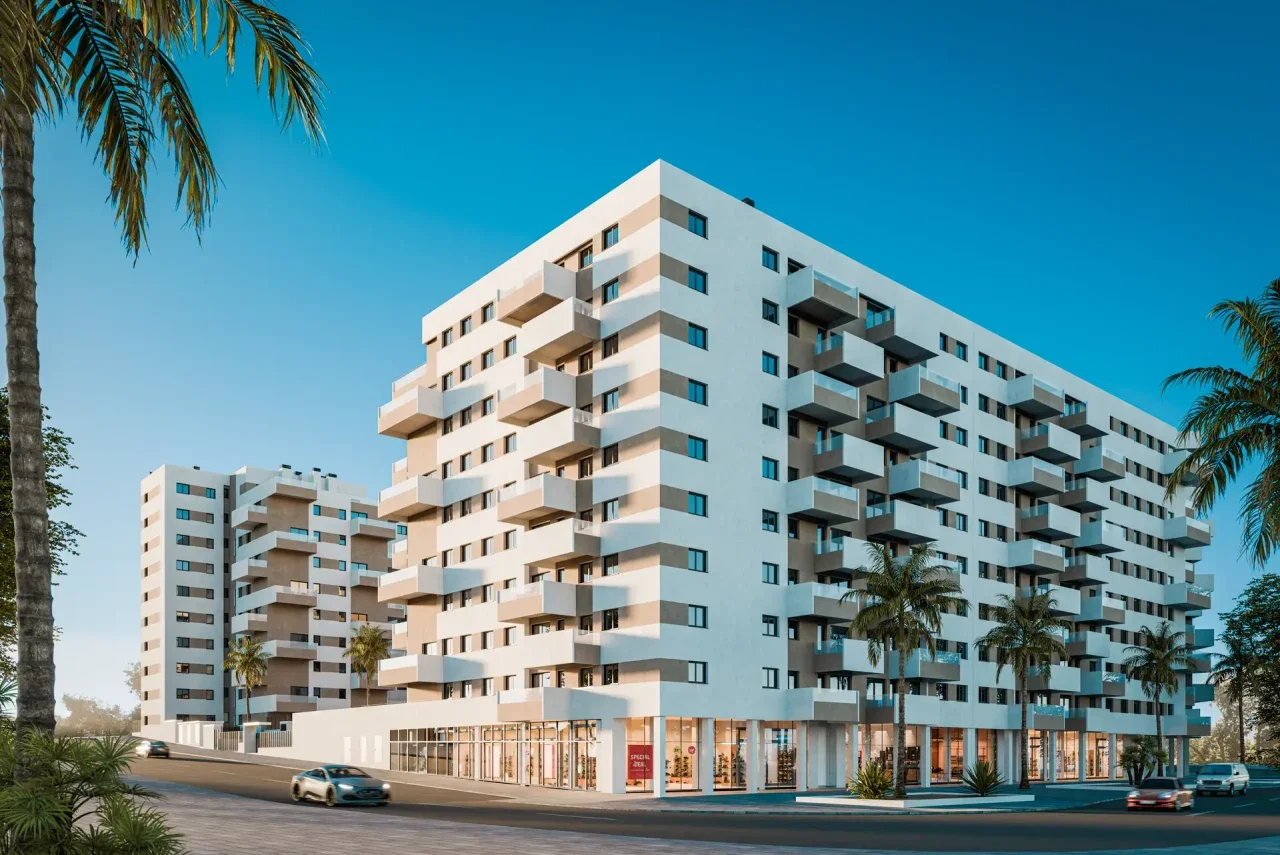
Quick answer: Elyonia is 448 homes by Grupo Insur in Entrenúcleos, a planned district of Dos Hermanas inside the Seville metropolitan area. Almost every assumption this site’s coastal pages rely on is inverted here: no beach, no tourist-let market, no foreign-buyer premium, and a resale pool that is Spanish and mortgage-financed. What it offers instead is a large-scale scheme by a developer with a decade of delivered product in the same district, aimed at a year-round tenant base in Andalusia’s regional capital.
Related research: the Grupo Insur developer review · buy-to-let mechanics in Spain · non-resident rental tax.
What is Entrenúcleos, and why does the location decide everything?
Entrenúcleos is a planned urban expansion of Dos Hermanas, the large municipality immediately south of Seville. The name means “between centres”, which describes it exactly: it was laid out on land between existing settlements, with the street grid, services and transport connections designed in rather than accreted.
That planning origin produces a district with wide roads, allocated green space and school provision from the start, which is why it has absorbed a decade of continuous development. It also means the district is still filling in, so a buyer is purchasing into a place partly under construction rather than a finished neighbourhood.
The location fixes the investment logic before any detail about the building matters. Seville is Andalusia’s administrative and university capital, and the demand that reaches Dos Hermanas is people who work in that economy and want more space than central Seville offers at a price they can meet. That is a domestic, salary-driven, year-round market.
| Assumption that works on the coast | What actually applies at Elyonia |
|---|---|
| Foreign buyers set the price | Spanish salaries and mortgage capacity set the price |
| Summer short lets drive gross yield | Twelve-month contracts drive stable, lower gross yield |
| Tourist licence availability is decisive | Largely irrelevant; long-let regulation is what matters |
| Exit to an international cash buyer | Exit to a Spanish buyer needing mortgage approval |
| Seasonality is the main risk | Interest rates and local employment are the main risks |
Insider tip: ask which phases of the wider Entrenúcleos masterplan are still unbuilt and what is planned on the plots nearest your block. In a district still filling in, the view and the noise profile you buy are not necessarily the ones you keep, and the town hall’s planning file answers this better than a sales office will.
We can pull the current unit schedule, the terrace orientations still available, and the guarantee documentation before you reserve. One business day, independent of the developer.
Request Elyonia floor plans and phase availability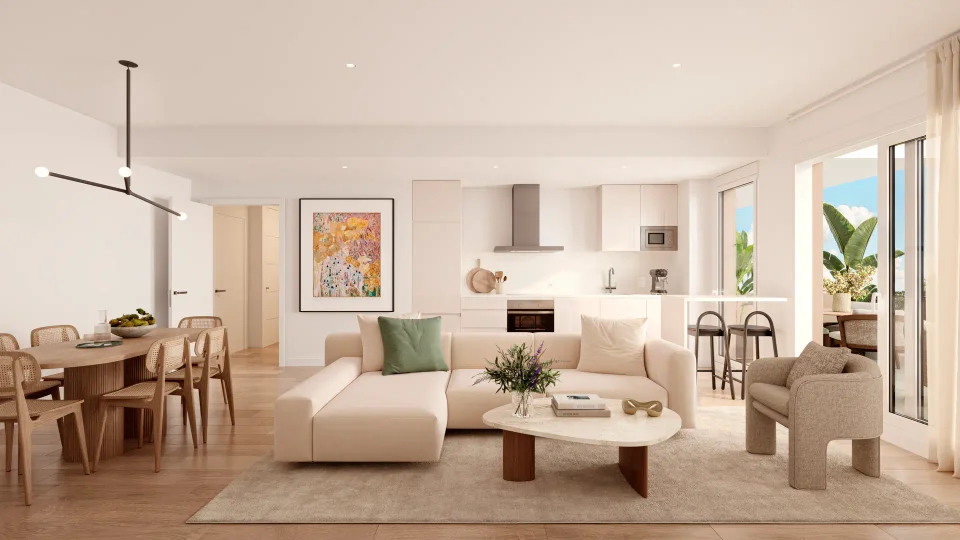
What has Grupo Insur actually built here?
Elyonia comprises 448 homes in two, three and four bedroom formats, positioned beside the planned Torre de Entrenúcleos. Communal provision includes swimming pools, a gym and a social club.
The architectural feature worth understanding is the staggered terrace arrangement. Rather than stacking balconies directly above one another, the blocks step so that terraces are offset. The practical results are more privacy from the unit above, more open sightlines, and outdoor space that is genuinely usable rather than overlooked. The layout also prioritises southern orientation and cross-ventilation.
In Seville that last point is not a marketing flourish. Summer temperatures here are among the highest of any major Spanish city, and cross-ventilation plus orientation are the difference between an apartment that is habitable in August with the air conditioning off and one that is not. It also shows up directly in running costs.
| Scheme fact | Position |
|---|---|
| Total homes | 448 |
| Unit mix | Two, three and four bedrooms |
| Signature feature | Staggered terraces, offset for privacy and views |
| Design priorities | Southern orientation, cross-ventilation |
| Communal areas | Pools, gym, social club |
| District | Entrenúcleos, Dos Hermanas, Seville metropolitan area |
| Developer | Insur Promoción Integral, part of Grupo Insur (ISUR) |
| Developer’s local record | 10 years in Entrenúcleos, 15+ promotions, 2,200+ homes |
That last row is the most useful diligence asset on this page. A developer with fifteen delivered schemes in one district has left fifteen pieces of evidence standing within a short walk. You can visit them, look at how the render and the brickwork have aged, and ask a community administrator what the monthly charge settled at once the pools were running. Almost no off-plan buyer anywhere gets that quality of comparison, and it costs an afternoon.
What does the scale of 448 homes do to the investment?
Scale cuts both ways and the brochure will only mention one side.
In your favour: communal facilities are funded across a large community, so pools, a gym and a social club cost each owner less per month than the same facilities on a small block. A larger community also tends to have a more professional administrator and a more robust reserve fund.
Against you: 448 broadly similar units will reach the resale and rental markets over time, and a meaningful number will do so in the same window. If you need to sell a three-bedroom unit in a year when eleven identical three-bedroom units are also listed, you are competing on price against near-identical stock. On the coast that competition is diluted by international demand arriving from many directions; in a domestic commuter market it is not.
- Differentiate at purchase. Orientation, floor, terrace depth and parking allocation are what distinguish your unit from its neighbours later, and they are cheap to choose now and impossible to change afterwards.
- Check the reserve fund. Large communities with substantial facilities face large periodic bills; a low monthly charge with no reserve is a deferred cost.
- Assume rental competition from within the building. Your comparable is the identical flat two floors up, which caps what you can ask.
- Plan a realistic marketing period. A domestic resale market moves at mortgage speed, not cash speed.
What does an Andalusian purchase cost above the price?
Andalucía applies one of Spain’s lower new-build stamp duty rates, which is a genuine advantage of buying in this region rather than in Murcia or the Comunitat Valenciana.
| Line | On a €240,000 unit | Note |
|---|---|---|
| List price | €240,000 | Confirm against the current unit schedule |
| IVA at 10% | €24,000 | State rate on new build |
| AJD at 1.2% | €2,880 | Andalucía, among the lowest regional rates |
| Notary and land registry | roughly €1,900 to €2,800 | Scales with price and deed |
| Independent legal work | roughly €2,400 to €3,000 | Around 1% plus VAT |
| Indicative all-in | roughly €271,200 to €272,700 | Around 13.2% above list |
For comparison, the same €240,000 purchase in the Región de Murcia would carry AJD at 1.5% and in the Comunitat Valenciana 1.4% from 1 June 2026, so Andalucía saves roughly €720 against Murcia on this ticket. It is not decisive, but it is real, and it compounds on larger units.
Andalucía’s resale ITP is a flat 7%, which matters for your exit rather than your entry: a future buyer purchasing your unit as a resale pays 7% rather than the 10% IVA you paid, which slightly improves your unit’s competitiveness against new stock still being sold in the district.
How should the rental case be built?
Underwrite this as a long let. The tenant is a Seville-employed household that wants more floor area than central Seville offers at the rent they can pay, and the contract is a twelve-month residential lease under the Ley de Arrendamientos Urbanos.
That legal framework matters more here than the licence framework that dominates the coastal pages. A residential tenancy in Spain gives the tenant substantial security of tenure, and a landlord planning around that reality has a very different model from one imagining a property they can reclaim seasonally.
- Expect stability rather than height. Gross yields on domestic long lets are typically lower than licensed coastal short lets, and vacancy is far lower.
- Budget the community charge honestly. Pools and a gym across 448 homes are cheaper per owner than on a small block, but they are not free.
- Air conditioning is not optional in Seville. Its running cost belongs in the tenant’s affordability calculation, which means it belongs in yours.
- Non-resident tax applies as everywhere. 19% on net for EU and EEA residents, 24% on gross for everyone else, and on a long let with real deductible costs that gap is substantial.
A non-EU landlord should be especially careful here. In a long-let model with predictable running costs, the EU-resident owner deducts those costs before tax and the non-EU owner does not. On a modest gross rent with meaningful community and maintenance charges, that difference can consume most of the margin. Our non-resident rental tax guide works the arithmetic through.
What actually generates the rent here?
A coastal page can wave at “tourism” and be roughly right. An inland commuter asset cannot, because its rent comes from identifiable employers and a specific commute, and if those weaken the yield weakens with them.
Seville’s economy rests on public administration as the seat of the Junta de Andalucía, a large university and hospital system, an aerospace and industrial cluster in the metropolitan area, and tourism concentrated in the historic centre rather than in Dos Hermanas. Dos Hermanas itself is one of Andalusia’s largest municipalities by population and carries its own industrial and logistics employment rather than functioning purely as a dormitory.
That produces a tenant pool with two distinct components, and they behave differently:
| Tenant type | What they want | What they will pay for | Risk to you |
|---|---|---|---|
| Seville commuters | Space and price relative to central Seville | Extra bedroom, parking, terrace | Sensitive to commute time and fuel or fare costs |
| Local Dos Hermanas employment | Proximity to work, family-sized flats | Schools, parking, quiet | Tied to specific local employers |
| Public sector and hospital staff | Stability and twelve-month certainty | Condition and management responsiveness | Low: salaries are secure |
| Students | Cheapest viable option | Almost nothing | High churn, September-anchored |
The commuting component is the one to verify personally rather than accept. Journey time from Entrenúcleos into central Seville at eight in the morning is not the same as the off-peak figure a sales office will quote, and that gap is precisely what determines whether your flat competes with one closer in. Drive it, or ride it, at rush hour before you buy.
Worked long-let case. Take a three-bedroom Elyonia unit bought at €240,000, which lands in the all-in range set out in the cost table above once IVA, AJD, notary, registry and legal work are counted. Let it at €900 a month on a twelve-month contract and gross rent is €10,800 a year. Deduct community charges, IBI, insurance, a maintenance provision and a letting agent’s fee, and roughly €3,000 of genuine annual cost is realistic on a scheme carrying pools and a gym, leaving about €7,800 net before tax. An EU-resident owner pays 19% of that net and keeps roughly €6,300, which against the all-in capital is a return in the low twos as a percentage. A non-EU owner is taxed at 24% of the full gross with nothing deductible, pays about €2,592, and keeps roughly €5,200, or a return closer to 1.9%.
Those are not exciting numbers and they are not meant to be. They are what a stable domestic long let in a Spanish provincial capital actually produces, and any presentation showing double that figure for this scheme is either quoting gross against list price, ignoring tax, or importing a coastal short-let assumption. Test every yield claim against this structure before believing it.
Who is this right for?
It suits a buyer who wants Spanish residential exposure priced on domestic fundamentals rather than international sentiment; a buyer who values a developer with a verifiable delivery record in the exact district; and a landlord content with steady long-let income and low seasonality.
It does not suit anyone buying for holiday use, because there is no coast and no holiday market. It does not suit a short-let operator. It does not suit a buyer who wants the international resale liquidity that the Alicante and Málaga foreign-buyer shares represent. And it does not suit a buyer who has not tested whether they are comfortable with a Spanish residential tenancy’s security of tenure.
If the appeal was Andalusia rather than Seville specifically, Málaga province coastal stock offers the international demand profile at a considerably higher entry. If the appeal was the low ticket, Murcia city is the closest comparable inland proposition on this site.
What should you verify before reserving?
- Confirm the promoting entity on the reservation document matches the entity named on the bank guarantee certificate.
- Require an individual Ley 57/1968 certificate for every staged payment, naming you and the exact sum, and confirm it directly with the issuing bank.
- Choose orientation and floor deliberately, and get the terrace dimensions and the parking bay identified in writing.
- Walk the delivered Grupo Insur schemes nearby, and ask a community administrator what the monthly charge actually became.
- Check the Entrenúcleos planning file for what is scheduled on adjacent plots.
- Ask for the community budget and the reserve fund provision, not just the estimated monthly figure.
- Instruct a lawyer independent of the developer and of any introducing agent, before paying anything.
- Model the return on a twelve-month lease at market rent, with real IBI, community charges and the correct non-resident tax treatment for your nationality.
- Confirm the licencia de primera ocupación is issued for your block before completion, and inspect against the handover checklist.
Red flag: any presentation of this scheme that uses coastal yield language, holiday-let projections or foreign-buyer statistics. Those belong to a different market roughly eighty kilometres away, and their appearance in Entrenúcleos material means the numbers have been imported rather than calculated.
Request floor plan + price list
Get the current unit schedule, payment stages, and bank-guarantee checklist for Insur Elyonia. Our Spain advisors reply within one business day with lawyer-ready next steps.
Frequently Asked Questions
448, in two, three and four bedroom formats, making it one of the largest single schemes covered on this site. Ask which block and phase your unit sits in, because completion dates within a scheme of this size are not uniform.
No. Entrenúcleos is in Dos Hermanas, inside the Seville metropolitan area and roughly 80 kilometres inland from the Atlantic coast. Any coastal or holiday-let framing applied to this scheme has been copied from a different market.
They are staggered rather than stacked, so each terrace is offset from the one above. The intended results are privacy, open sightlines and genuinely usable outdoor space. The blocks also prioritise southern orientation and cross-ventilation, which in Seville's summer is a running-cost issue as much as a comfort one.
New build in Andalucía is 10% IVA plus 1.2% AJD, one of Spain's lower regional rates, with notary, registry and independent legal work adding roughly 1.5% to 2%. On a €240,000 unit budget roughly €271,200 to €272,700 all-in.
Almost certainly a Spanish buyer with a Spanish mortgage. Seville province's foreign-buyer share sits in single digits against Alicante's 43.29% and Málaga's 32.80% in 2025, so your exit depends on domestic lending conditions rather than international cash demand.
Steps common to every Spanish new build are in the non-resident buyer checklist.
Get floor plan + price list
Name and WhatsApp only. We reply within one business day with unit schedule and payment stages.